






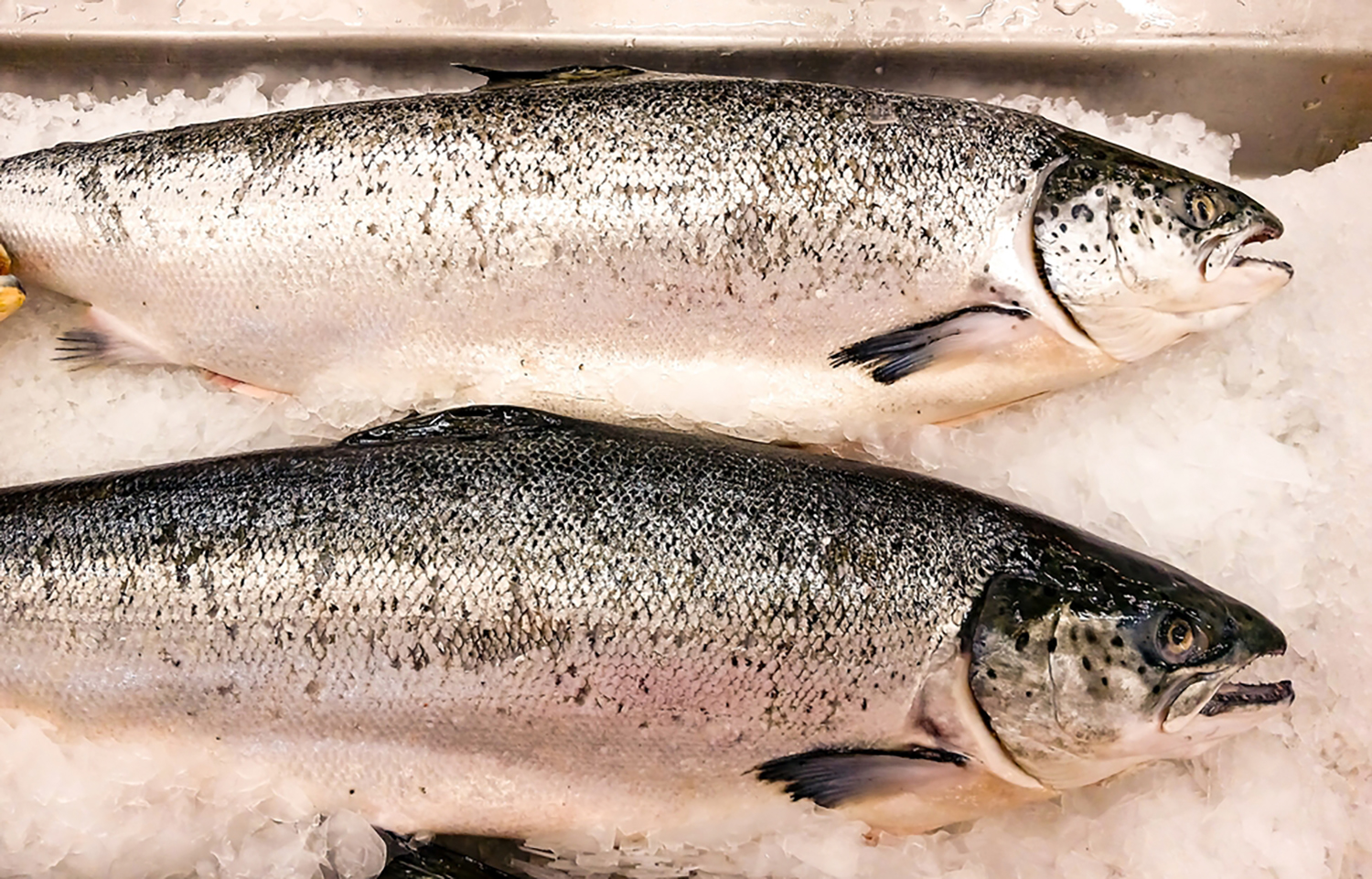
The global Atlantic salmon-farming industry is now in a period of constraint, with slowing supply growth colliding with shifting trade dynamics, increasingly price-sensitive demand, and, more recently, escalating tensions in the Middle East, according to Kontali analysts Lars Daniel Garshol and Philip Scrase.
Giving their latest Global Salmon Market Update in the lead-up to the 2026 edition of Seafood Expo Global, Garshol and Scrase explained that after years of expansion, there is now declining harvest-ready biomass across key salmon-producing regions – including Norway, Chile, and Scotland.
“We’re entering a phase where there is limited and potentially negative supply growth,” Garshol said, adding that this shift marks a departure from the industry’s traditional growth model and is expected to reshape competition across markets.
While supply tightens, demand is being affected by increasing price sensitivity, creating an environment in which product innovation and promotional strategies will be critical to sustaining demand, Scrase said.
In Europe, for instance, sales growth has stagnated by both volume and value in recent years but has at least remained relatively stable, underpinned by retail/home consumption that accounts for roughly 70 percent of the market.
“It's a price-sensitive market, but it has also created a very strong, stable base for Atlantic salmon,” Scrase said. “While this market loses out in periods of short supply, it does give the market a lot of flexibility.”
Elsewhere, markets in Asia, particularly China, are expected to absorb a larger share of global supply in the coming years, Garshol explained.
“China is – and will remain – the key growth market for salmon going forward,” he said. “We’re also going to see positive effects from the lower U.S. tariffs, if they remain in place. [There’ll] definitely be more volumes over time, and more demand potential from China.”
However, in the near term, escalating tensions in the Middle East are placing strain on shipments to global markets, including Asia.
Garshol and Scrase explained that one of the most immediate impacts of the conflict has been a sharp increase in fuel prices, with jet fuel costs more than doubling in a matter of a few weeks.
Citing International Air Transport Association (IATA) data, they said that following the escalation, the global average jet fuel price rose from around USD 99 (EUR 84) per barrel on 27 February 2026 to USD 209 (EUR 177) per barrel on 3 April.
More critical than these rising costs is a reduction in available freight capacity, Garshol said, explaining that disruptions to flight routes and declining airline capacity are limiting the volume of seafood that can be shipped, particularly on key routes to Asia.
“The most important factor is not the freight rate itself; it’s the logistical capacity,” he said.
Historically, salmon shipments from Europe to Asia have benefited from return freight dynamics, allowing exporters to access relatively low-cost cargo space.
This advantage is now diminishing, Garshol explained.
“If you need to put in new cargo capacity, you will face significantly higher rates,” he said. “Logistics costs can have a similar real-world effect as tariffs.”
Among other factors, higher transport costs increase the landed price of salmon, potentially dampening demand in aforementioned price-sensitive markets, the analysts said, confirming that the combination of geopolitical instability and logistical disruption is contributing to heightened market volatility.
“We’re seeing big changes from week to week, and the risk of [this] volatility is increasing, driven by external factors that can’t really be controlled,” Garshol said.
At the same time, some relief has come in the form of recent changes to U.S. tariffs and trade policy, which Scrase suggested has been the “number one” influencing factor in global seafood trade over the past 18 months.
“Following the U.S. Supreme Court ruling in February, most tariffs introduced in 2025 were found to be illegal. They were then replaced with a new global 10 percent levy on imports,” Scrase said. “From our perspective, this is positive, [resulting in] mostly lower rates compared to 2025 and a simplification across species and origins.”
This will “give more predictability and a more level playing field,” Scrase said but added that for salmon, the change will likely be moderate since the average tariff was already around 10 percent.
Shrimp suppliers, though, should see greater relief.
“[Shrimp is] the most affected category and the largest product in U.S. seafood consumption. The U.S. is also heavily reliant on imports, and with countries like India moving from tariffs above 50 percent to 10 percent, this will significantly affect trade flows,” Scrase said. “We are moving toward a situation where competition is driven more by fundamentals rather than trade policy differences. That said, risk remains elevated. Just this week, the U.S. administration discussed the possibility of introducing new tariffs this summer, so this is still something we need to monitor closely.”
