






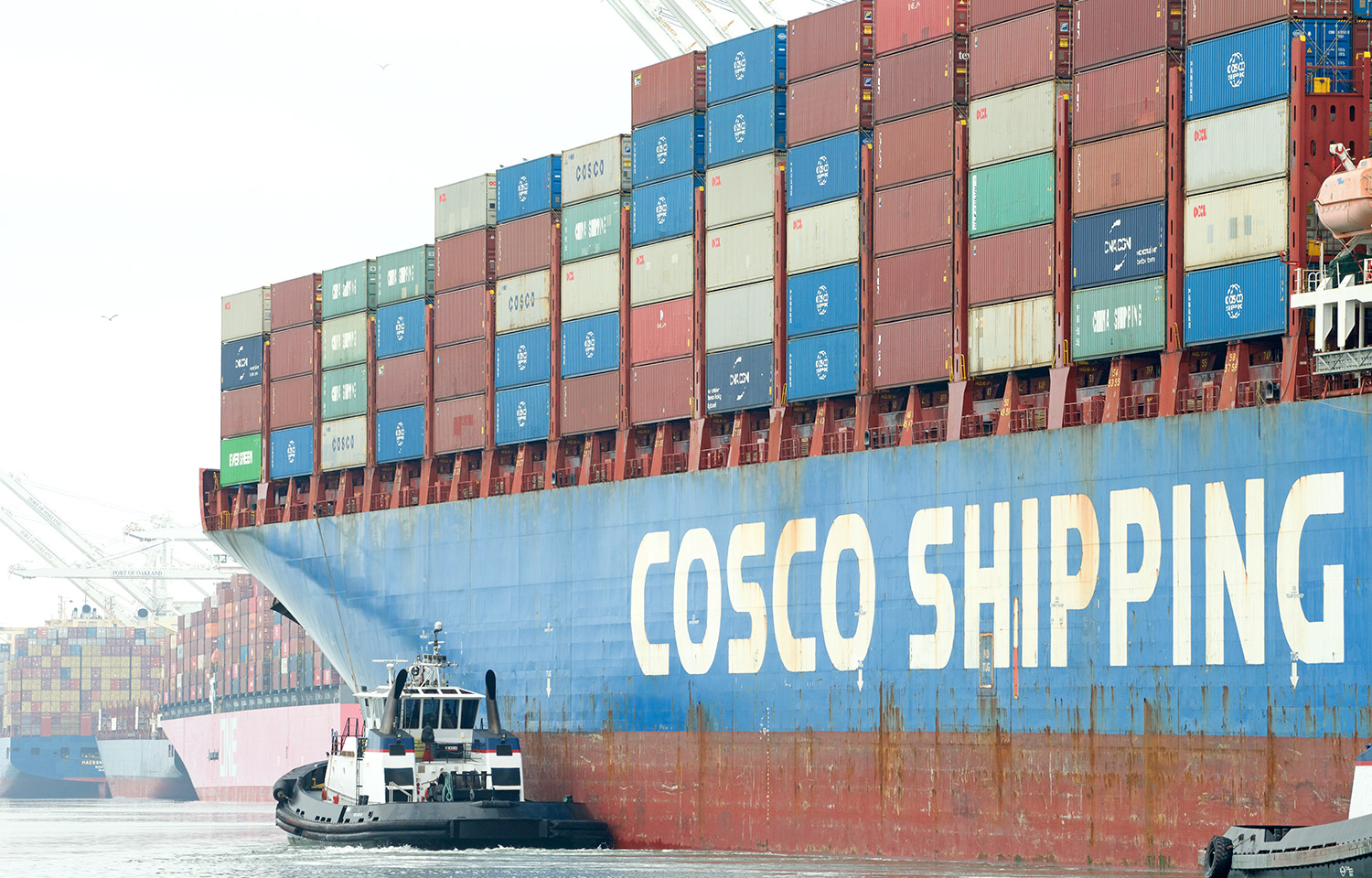
Container ports in the United States are seeing elevated cargo levels, according to the Global Port Tracker report released by the National Retail Federation (NRF) and Hackett Associates. The report comes amid rising uncertainty over tariffs in the U.S., where President Donald Trump’s rapidly evolving trade policy has shaken up the shipping industry and sent a chill through markets.
NRF Vice President for Supply Chain and Customs Policy Jonathan Gold said that uncertainty around tariffs, particularly those on goods from China, is leading retailers to rush their imports into the country.
“Retailers are continuing to bring as much merchandise into the country ahead of rising tariffs as possible,” he said. “The on-again, off-again tariffs against Canada and Mexico won’t have a direct impact on port volumes because most of those goods move by truck or rail. But new tariffs on goods from China that have already doubled from 10 percent to 20 percent are a concern, as well as uncertainty over ‘reciprocal’ tariffs that could start in April. Retailers have been working on supply chain diversification, but that doesn’t happen overnight. In the meantime, tariffs are taxes on imports ultimately paid by consumers, not foreign countries, and American families will pay more as long as they are in place.”
The pain is already being felt by importers and exporters. Supreme Crab CEO Troy Turkin recently told SeafoodSource that “due to the 45 percent total tariff amount going into effect now, we will likely need to move a large portion of our buying away [from] China.”
Landy Chow, marketing manager for seafood import/export firm Siam Canadian, similarly told SeafoodSource that a 45 percent tariff was “simply too high.”
Adding to the confusion is the U.S. Trade Representative’s recent proposal that Chinese-built and operated ships be charged fees each time they enter U.S. ports. Ben Hackett, Founder of Hackett Associates, said that such fees would only pass even higher prices to consumers.
“Given that a significant portion of the global container fleet has been built in China, this means that there will be further costs that will be passed on to cargo owners and ultimately the consumer,” he said.
There could also be unintended consequences for all the nation’s ports, Hackett explained. He anticipated that carriers might adopt larger vessels to consolidate calls, rather than making multiple stops at smaller ports. This would mean heavier volume at large ports and declining business at smaller ones.
“Ports accommodated the surge in import volume in the final quarter of 2024 without major issues, but this will place additional pressure on the supply chain while also harming the nation’s smaller ports,” Hackett said.
According to the report from Global Port Tracker, January saw 2.22 million twenty-foot equivalent units (TEUs) entering the country, up 4.4 percent from December and 13.4 percent from January 2024.
Though February is usually a slow month for the ports thanks to Lunar New Year, which shuts down Chinese factories, the Global Port Tracker predicts that Febrary will see 2.07 million TEU, up 6.1 percent from the previous year. If their predictions are accurate, that would make 2025 the busiest February on record for American ports.
The Global Port Tracker has currently forecast 2.14 million TEU entering the country in March, (a 10.9 percent year over year increase), April at 2.13 million TEU (a 5.7 percent year over year increase), May at 2.14 million TEU (a 2.8 percent year over year increase), June at 2.07 million TEU (down 3.2 percent), and July at 1.99 million TEU (down 13.9 percent).
The NRF said that “while tariffs might be a factor in the year-over-year decline [predicted in June and July], imports were elevated last summer as retailers brought in cargo ahead of what turned out to be a short strike at East and Gulf Coast ports in October.”
Global Port Tracker, produced by NRF and Hackett Associates, provides both historical data and forecasts for the U.S. ports of Los Angeles/Long Beach, Oakland, Seattle and Tacoma on the West Coast; New York/New Jersey, Port of Virginia, Charleston, Savannah, Port Everglades, Miami and Jacksonville on the East Coast, and Houston on the Gulf Coast.
