





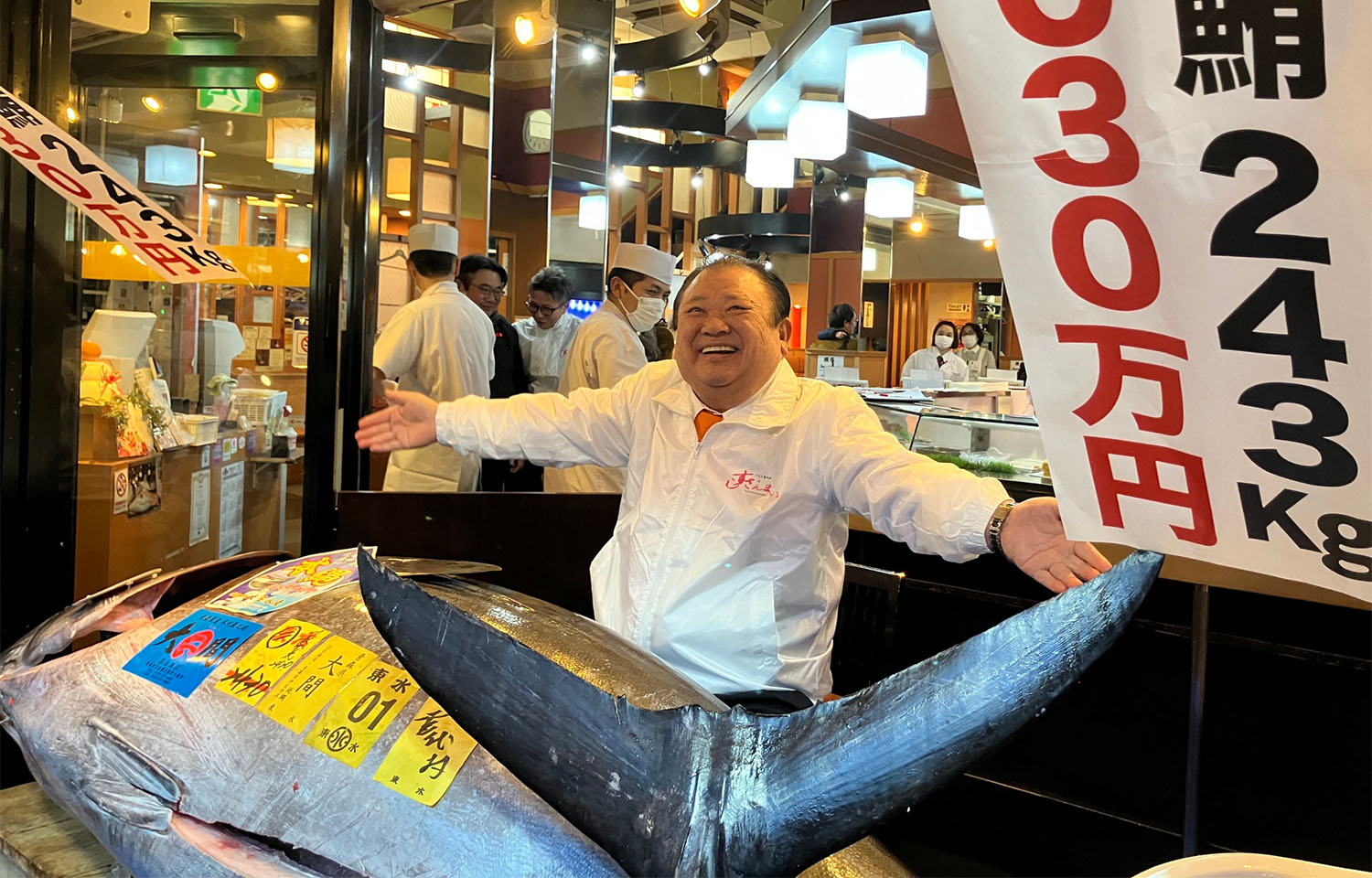
The first tuna auction at Toyko’s Toyosu fish market has reached a record price of JPY 510.3 million (USD 3.2 million, EUR 2.7 million).
The price went to a bluefin tuna caught off of the town of Oma in Japan’s Aomori prefecture that weighed 243 kilograms. The record price fetched for the fish beats the previous high of JPY 333.6 million (then USD 3 million, EUR 2.6 million) set in 2019.
Kiyomura, the company operating the Sushizanmai sushi chain, placed the bid, The Japan Times reported.
“I’d thought we would be able to buy a little cheaper, but the price soared before you knew it,” Kiyoshi Kimura, the head of the company, told media at a conference after his purchase. “I wanted to make a big splash to help lead the world. I hope many people will enjoy the tuna and feel energized.”
The high price for the top tuna at the first auction is an annual tradition, which largely equates to a PR stunt performed each year to gain attention to the company that placed the bid. Kimura has been dubbed the “tuna king” and was the head bidder for the previous record in 2019 and also for another high price in 2020.
The Covid-19 pandemic briefly interrupted his position as top bidder and drastically reduced the bid price, with the top tuna in 2021 going for just JPY 20.84 million (then USD 202,453, EUR 164,955). At the time, Kimura said Covid-19 regulations meant the normal tuna-cutting show he puts on after purchasing the prize wasn’t feasible.
As in prior years, Kimura announced on its Facebook page it was holding a tuna-cutting demonstration and selling a piece of the prize tuna to guests at regular price at its location in Tsukiji, Tokyo.
The publicity event has also historically been used by NGOs to highlight the conservation status of Pacific bluefin tuna.
"Toyosu Market's first Pacific bluefin tuna auction of the year is a special moment, highlighting the cultural and economic importance of this species. It is a time to celebrate, given very recently the stock was severely depleted and near collapse,” The Pew Charitable Trusts Senior Officer Dave Gershman said in a release.
In years past, environmental groups mainly pointed out the poor status of the species and overfishing issues. Ocean Foundation Project Director of International Fisheries Conservation Shana Miller told SeafoodSource that just 10 years ago, Pacific bluefin tuna’s stock was at just 2 percent of its historical size.
Since that low point, fisheries managers reduced quotas and, in 2017, put an official rebuilding plan into place – which Miller said has worked well. The species reached a rebuilding target in 2019 – five years ahead of schedule – and the Monterey Bay Aquarium Seafood Watch Program lifted its rating to yellow as the status of the stock improved. In 2024, the stock assessment found bluefin tuna was back to 23 percent of its original size.
“We’ve seen a tremendous resurgence of the stock, showing if you give these fish a chance to recover, they do and do so quickly,” Miller said.
Gershman said the recovery plan created in 2017 for the species is working, and he urged RFMOs covering the species to continue that work in 2026.
"This year, fisheries managers from Japan, the United States, Korea, and other countries from across the Pacific that target bluefin should agree on a long-term, sustainable management plan that would lock in a healthy population and ensure that the species never again faces the overfishing of the past,” Gershman said.
Miller said the joint working group of the Inter-American Tropical Tuna Commission (IATTC) and the Western and Central Pacific Fisheries Commission (WCPFC) meet each year to discuss bluefin tuna management given its migratory nature across the boundaries of their coverage areas, and in 2024, they voted to increase the basin-wide catch limits on Pacific bluefin by 60 percent in 2025 and 2026.
“That was concerning to some because it was such a quick change,” she said. “Hopefully that hasn’t hurt the recovery at all.”
Pew and other NGOs like the International Seafood Sustainability Foundation have pushed RFMOs to adopt a harvest strategy for bluefin tuna, but the joint working group failed to enact any new strategies in 2025.
Harvest strategies, also known as management procedures, set pre-determined scientific limits and metrics on managing a fishing stock, allowing an RFMO to quickly adapt to any stock changes without having to go through a voting process.
Gershman told SeafoodSource before the prior IATTC meeting that adopting a harvest strategy could help solidify the sustainability of tuna stocks including Pacific bluefin.
“The key thing here is that with that sort of pre-agreement, everyone has the same expectation and the same understanding and you can take action before there’s a crisis,” Gershman said.
Miller said there’s a plan to potentially implement a strategy this year.
“There’s a good number of options on the table that can really lock in that recovery and lock in the profitability of the fishery,” she said.
