






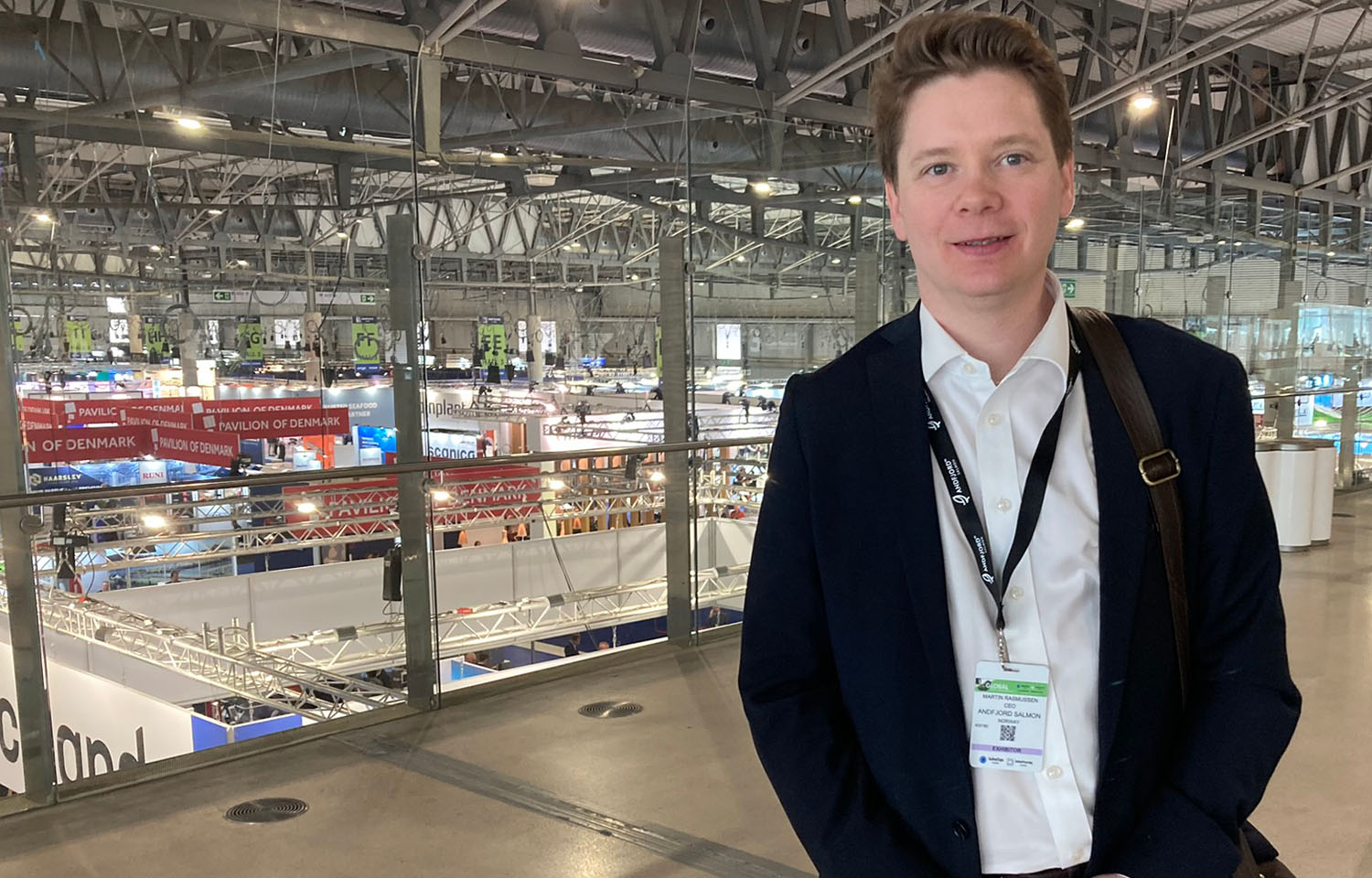
Martin Rasmussen is the CEO of Andfjord Salmon, which is building a flow-through land-based salmon farm on the island of Andøya, in the Arctic archipelago of Vesterålen, Norway. It recently concluded a NOK 350 million (USD 32.9 million, EUR 30.3 million) private placement and has applied to conduct a subsequent offer of shares on the Euronext Oslo stock exchange, where it is listed. On 29 May, the company reported an operating loss of NOK 17 million (USD 1.6 million, EUR 1.5 million) in Q1 2024, compared to a loss of NOK 13.9 million (USD 1.3 million, EUR 1.2 million) in Q1 2023.
SeafoodSource: How do you present Andfjord Salmon to potential investors?
Rasmussen: We are utilizing the natural advantages we have in the north of Norway, where we have unique access to water that we don't have to manipulate. Yes, we’re a new company with a new concept, but the truth is that we have 20 years of history and development behind us.
The founder [Roy Bernt Pettersen] is from Andøya, and he's been working with fish his entire life. He found out that we had two or three degrees higher temperatures in the local water as compared to the fjords around us, which can give us higher salmon growth. After we discovered this, it’s about coming up with the best concept and then proving that concept, which I believe we have done now with our very good biological performance.
SeafoodSource: Norway is a powerhouse of traditional net-pen salmon farming. Why do something different there? How have you been received by the industry in Norway?
Rasmussen: In the start, when you are doing something new, you're challenging the traditions. We received a lot of questions when we were starting as to why we were farming salmon on land in an area where we have such good conditions for traditional methods. But, we have come to a point, especially in Norway, where it is getting difficult to have more growth for salmon farming.
We are still utilizing the well-known technology used in commercial salmon farming for many years but doing it in a much more controlled environment. What we have done is actually to move a traditional net cage on land, so then we can protect it against, for example, sea lice, jellyfish, and algae.
At the same time, we are protecting nature with having so many salmon in one place. We have a very good concept on behalf of the biology, and it's very energy-efficient since we are located in water where the salmon has been swimming in for many thousands of years – it’s a natural environment to them.
SeafoodSource: What is the current situation at the farm?
Rasmussen: We have already built one pool and released almost 200,000 salmon into it. It's important to understand that this is quite a large pool; it's 30,000 square cubic meters, which is pretty similar to a traditional net pen. So, the fish have enough space [to exhibit] natural behavior in the pool. After a one-year production cycle, we achieved a survival rate of 97.5 percent, which demonstrates the fish is doing very well in the pool.
Additionally, we have had almost 40 percent better growth compared to our initial production plan. We have also seen a better feed conversion rate, so we have proven that we can produce 1 kilo of salmon with 20 to 30 percent less feed than commercial net-pen salmon farming because of the controlled environment.
In general, we're extremely proud of what we have proven with the first production cycle. The concept is good, and we have a lot of skilled people with us, including our management, our shareholders, and our board.
SeafoodSource: Would you say you now have proof of concept? Are you there yet?
Rasmussen: We have proven that the concept is working. We have proven the technology. We have proven it with its actual scales – the business is in its representative scale – and it's now more about commercializing the company by increasing production capacity.
We are just getting into the phase of construction and starting to ramp up production. We're in a construction phase for the entire Kvalnes area, where we have a license for 10,000 tons and have identified a plan to produce 19,000 tons of salmon every year. We will have four new pools ready next year, which will give us production capacity of 8,000 tons every year. Thereafter, we will have four new pools every year until we have reached full utilization of our land and sea area.
SeafoodSource: Do you have other sites planned, as well?
Rasmussen: When we saw the potential of the local area, we wanted to secure more land area on the island to give us enough area to produce 90,000 tons per year at three different locations. It takes time to develop the property, and there is a regulatory regime that requires a lot of documentation, which we have respect for, but that is our plan.
SeafoodSource: Costs for construction projects all over the world have risen along with interest rates, material prices, and labor. How have you kept up with that as you're building and as you're planning other sites?
Rasmussen: We are within our budget and our timelines; really, we're actually in front of our schedule. The concept is largely about creating enough space so we're not so impacted by inflation on the raw material. When it comes to the financing, I think it's extremely important to find a good shareholder base early in the stage.
Now, we have industrial shareholders with us; for example, our largest shareholder is Jerónimo Martins, a company from Portugal that is one of the largest retailers in Europe. Our financing is in order now for the phase we are within, so we are in a very good financial position. We also have very good dialogues with the banks, which seem convinced this is a very beneficial method to produce good salmon in Norway.
SeafoodSource: Andfjord recently announced a plan for growing and selling post-smolt in its pools. Can you describe reasoning behind that decision?
Rasmussen: We're surrounded by traditional salmon farmers, which opens up the possibility of a market for post-smolt. Since we have very large pools, we wanted to increase the production capacity in the early stage because it's a large house when the fish is small. So, we identified a plan of how to utilize this surplus capacity, and since we also have a traditional salmon farmer on board as a shareholder, we found a way to really utilize our capacity and their capacity.
We see this as very sustainable solution to grow volumes both on land and also in the sea. I think this strategy is opening up more opportunity, and it also will be important for other traditional salmon farmers in Norway to look into this as a way of using new technology to solve many of the issues that we have in the sea.
SeafoodSource: You have the retail partnership with Jerónimo Martins, and you’ve shown you’re able to raise a significant amount of capital to fund your build-out. Do you think Andfjord can be looked at as a model for how land-based aquaculture can be developed? For some, it’s still viewed as experimental technology.
Rasmussen: I think we have proven our method, and many other companies have looked into how we have achieved the performance we are doing. I think also we see, in general, that many of the land-based salmon-farming companies are now succeeding, especially on biological performance [metrics]. We are now proving that it's possible to do good salmon farming on land.
SeafoodSource: What is the future of land-based salmon farming – not just in Norway but globally?
Rasmussen: What we're seeing now is that there's not only one solution, that we have many good ways of producing healthy and sustainable seafood. Each company has its own concept, and they should utilize their advantages based on where they are.
In other parts of the world, you may need more sophisticated technology, but for us, we can use a lot of the gifts from nature around us. Overall, I'm very convinced that we will see a lot of good producers and companies in the future for new methods of producing salmon. The market is there.
