



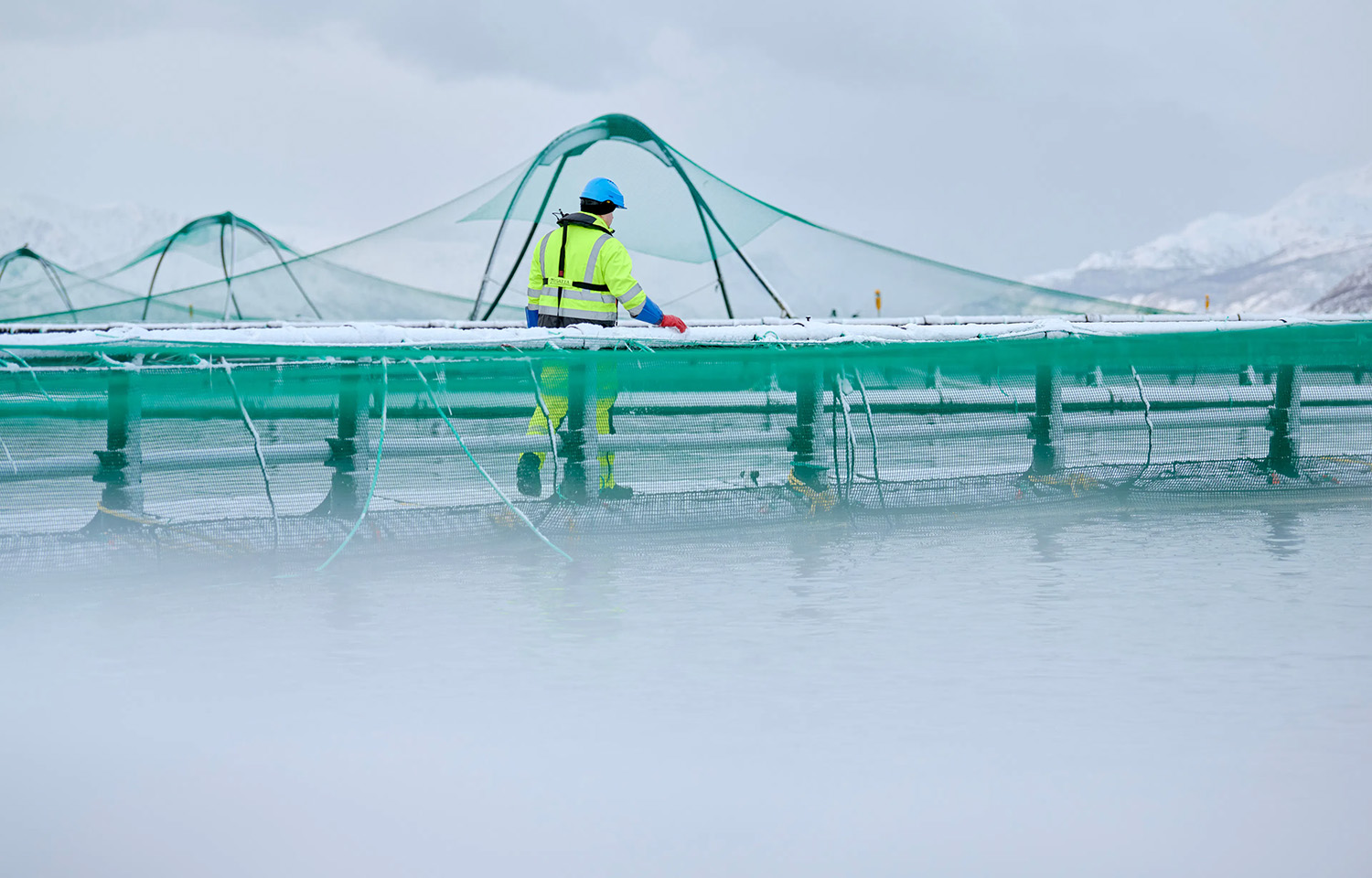
Frøya, Norway-headquartered salmon-farming firm SalMar saw increased salmon production in Q1 2026, while Bergen-based Grieg Seafood warned sea lice pressure reduced survival rates, forcing it to revise its EBIT predictions downward.
SalMar harvested 60,300 gutted weight tons (GWT) of Atlantic salmon in Q1 2026, an increase of 17,600 GWT compared with the harvest reported in Q1 2025.
According to its latest trading update, this latest volume total in Q1 2026 comprised 35,900 GWT from its Farming Central Norway segment, up from 21,100 GWT in 2025; 20,400 GWT from Farming Northern Norway, up from 19,300 GWT; 300 GWT from SalMar Ocean, down from 1,200 GWT; and 3,700 GWT from Icelandic Salmon, up from 1,100 GWT.
Its Q1 2026 report will be released on 20 May.
The producer previously guided a 2026 volume of 296,000 GWT from Norway, Ocean Farming, and Iceland, while Scottish Sea Farms was forecast to harvest 43,000 GWT on a 100 percent basis. Adjusted for SalMar’s ownership share, the total expected group harvest volume is currently 318,000 GWT.
Meanwhile, Bergen-based Grieg Seafood harvested approximately 8,200 GWT of salmon in Q1 from its remaining Rogaland farming operations, located in the west of Norway, which was 800 GWT more than a year previously.
In February this year, Grieg estimated a Q1 harvest of 6,600 GWT and a full-year 2026 volume of 31,000 GWT. However, the company’s new update explained that following high seawater temperatures in the second half of 2025 brought elevated sea lice pressure and a reduced survival rate.
To address this, it initiated mechanical delousing treatment during this period, but the decision was made ahead of an unexpected period of prolonged cold seawater temperatures in Q1 2026.
These elements combined to lower the share of superior-quality fish to just 60 percent – resulting in a lower price realization and higher harvest volumes with elevated farming costs.
Grieg is now estimating the EBIT impact for 2026 to be in the range of NOK 50 million to NOK 75 million (USD 5.3 million to USD 7.9 million, EUR 4.5 million to EUR 6.7 million), with most of the hit coming in Q1 2026 and only limited effects anticipated for the remainder of the year.
“This outcome is not satisfactory, and decisive actions have been implemented to avoid similar situations in the future. The respective mechanical treatment has been discontinued,” the update stated.
It also advised the majority of the fish currently in sea and planned for harvest in 2026 have not been subjected to the treatment.
“The incident is not reflective of the strong historical performance in Rogaland and is to a large extent considered a one-off event,” the company said.
According to Grieg, the average number of treatments per post-smolt group remains below one, even including the increased treatment activity.
While the company recently changed its financial reporting frequency from quarterly to half-year reporting, it confirmed that an extended trading update for Q1 2026 will be published on 21 May 2026.
It divested its salmon-farming operations in Finnmark, Norway, as well as the Canadian provinces of British Columbia and Newfoundland, to the Cermaq Group in 2025.
