


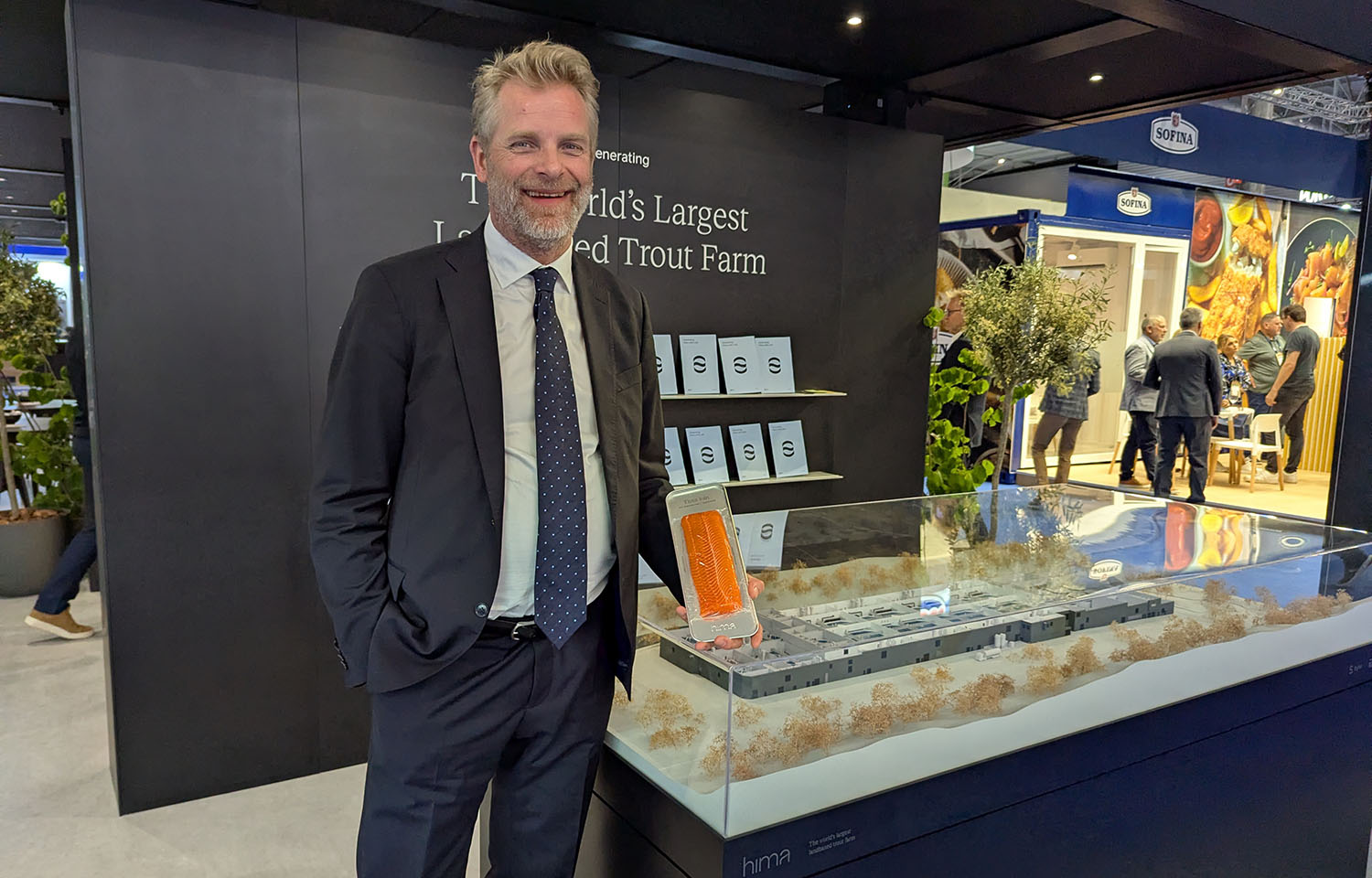
Byrne, Norway-based Hima Seafood is months away from the first harvest of trout from its recirculating aquaculture system (RAS), which it said is the largest land-based trout farm in the world.
Hima Seafood CEO Sten Falkum told SeafoodSource during Seafood Expo Global – which ran from 6 to 8 May in Barcelona, Spain – that the fish are approaching 4 kilograms, and a harvest will come in the next few months.
“We have tested all parts of the equipment and all parts of the facility are now in use,” Falkum said. “All the main technology components are working and adjusted, so we believe we have a fully operational and perfectly performing RAS facility at the moment.”
To get to that point, the company had to find solutions for several problems that hadn’t been solved before – including how to transfer large fish in a closed RAS system with zero damage.
“We have had a lot of learning, and much of the facility you see here, we’ve had to kind of develop it ourselves,” Falkum said. “There’s no map to learn from, more or less, but now we have been farming for four batches of trout.”
He also said the company has chosen to be a freshwater facility, rather than a saltwater one, because it reduces the chance of any mortality incidents.
“It’s because we don’t have this H2S [hydrogen sulfide] gas, which you have when you have salinity,” Falkum said. “Many of the other RAS facilities, they use salinity, and then you have risk of developing a very dangerous gas that can kill off the fish. We have de-risked that by farming with fresh water.”
Falkum said the company has also solved the problem of off flavoring that can occur in fish raised in a closed system, which often accumulate geosmin – a chemical which can give the fish’s flesh a musty, earthy odor and taste.
“Basically they just have to swim a certain amount of time in cold, not-recycled water – so you need access to that,” Falkum said. “Then after a specific amount of time, we have been able to 100 percent remove the geosmin.”
The company was demonstrating its new production during Seafood Expo Global, and Falkum said the interest was great enough that it had already sold the entirety of its fish from the first year of production within one day.
“We strongly believe that this is a very high end, attractive product,” Falkum said.
Throughout the process of dialing in its facility, the trout have had no biological issues, and the RAS facility is at close to 99 percent survival rate – only slightly off from Hima’s goal of a 99.5 percent survival rate.
“What we are most proud of is closing in on scientifically verifying that it’s possible to farm 8,000 metric tons (MT),” Falkum said.
Outside of the obvious success of raising trout with a low mortality rate in a land-based RAS, Hima’s farm is also proving it is possible to run a facility with extremely low impact on the surrounding environment. The company recycles its solid waste into organic fertilizer, creating 4,500 MT of additional product with a high level of nutrients that can be used for nearby farms.
The farm also has an on-site processing facility, which will process the fish so that every piece is used.
“All the heads and bones, everything is utilized into organic fertilizer, except the fish,” Falkum said. “That is a very important part, because that is what gives us a 100 percent closed system – we don’t throw away anything.”
Hima’s farm is located in a national park, and because of its energy sourcing and processes, it manages to significantly reduce its carbon emissions.
Now that the first facility is up and running, the company is already looking to expand to a new facility.
“When we have this fully working pilot, which is full-scale, commercialized, and will be completed in a few months time, we immediately start on our expansion plans,” Falkum said. “We have identified and worked for a number of years to find the perfect site in the U.S. We have four sites in our control, which gives us the potential to produce 110,000 MT over a 10-year period.”
The company will move carefully, starting with one project and finalizing it before moving on to the next. Falkum said Hima will also build a new broodstock facility inside the U.S. in combination with another party, and will bring its global partners along as well.
“We think we’re going to be a very new breath of fresh air into the aquaculture industry,” Falkum said.
