






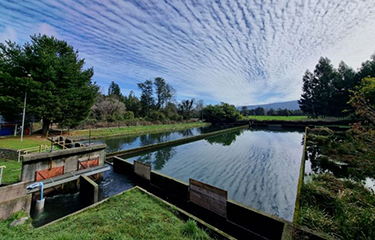
Chile’s Superintendence of the Environment (SMA) has filed charges against two fish farming companies operating in the central Chilean region of Araucanía due to alleged wastewater mismanagement and the subsequent proliferation of microorganisms in the discharge sectors of each farm’s respective bodies of water.
According to recent reports from the environmental watchdog, SMA detected breaches of the environmental permits each company requires to operate their individual projects. The detections directly stemmed from inspections performed by professionals from the SMA regional office in La Araucanía in conjunction with other sectoral agencies and subsequent legal analysis by the SMA’s sanction and compliance division (DSC).
The first sanctioning proceedings are against a local branch of Benchmark Genetics, owner of the Curacalco fish farm located in the borough of Cunco, 380 kilometers north of Puerto Varas. Its operations include the annual production of 3.2 million fingerlings and 2.06 million smolt from embryonic salmonid eggs.
SMA is bringing Benchmark up for three supposed breaches – two classified as serious and one as minor – for a total possible fine equivalent to a maximum of CLP 8.34 billion (USD 9.68 million, EUR 8.82 million).
The two serious infringements reportedly center on environmental permit breaches, specifically regarding an obligation the company made to ensure safe ecological flow and water collection from three underground wells.
The other accusation considered a lesser crime, concerns Benchmark Chile allegedly failing to inform or implement the measures necessary to address unforeseen environmental impacts in a timely manner, including the unmitigated proliferation of colonies of mucilaginous microorganisms in sectors of the Curacalco fish farm’s discharge channel, point of discharge, and downstream from the effluent discharge.
These types of microorganisms can negatively affect human health when present in large volumes of water sources.
The second set of charges is against the company Exportadora Los Fiordos, which owns the Estero Peuco fish farm located in the borough of Melipeuco.
Los Fiordos is, similarly, accused of failing to inform authorities in a timely manner or implementing the necessary measures to address unforeseen impacts having to do with the proliferation of microorganisms in sectors downstream of the farm’s effluent discharge.
The infraction, classified as minor, carries a fine of up to CLP 758 million (USD 880,000, EUR 801,000).
After the formulation of charges, each company has 10 working days from the date of notification to present a compliance program and 15 working days to formulate disclaimers.
SMA, along with the National Fisheries and Aquaculture Service (Sernapesca), has taken a much tougher stance against Chile's salmon-farming industry within the last year, which recorded a record USD 6.6 billion (EUR 6 billion) in exports in 2022. The legal crackdown on salmon farming rules violations stems back to around the time Chilean President Gabriel Boric entered office in January 2022, and that effort has ramped up further in recent months.
The environmental watchdog has significantly stepped up its control over the fish farming sector, particularly when farmers produce an amount of fish beyond which they are environmentally permitted to raise.
In February, based on information provided by Sernapesca, SMA subsequently initiated sanctioning processes against salmon firms in the Aysén and Magallanes regions. These included two Nova Austral operations and one Blumar farm in the Magallanes region, as well as a Multiexport grow-out center and one Mowi farm in the Aysén region.
SMA has also taken action against Nova Austral for alleged overproduction at three grow-out centers within Alberto de Agostini National Park and against Cooke Chile for alleged overproduction at farms located within the boundaries of national parks. Cooke has denied the allegations and called SMA’s enforcement efforts arbitrary.
SMA has also levied charges against Australis, accusing it of 85,000 MT of overproduction between 2014 and 2022. That company faces a total fine equivalent of up to CLP 178 billion (USD 206 million, EUR 188 million).
Overproduction generates an increased contribution of organic and inorganic matter and also raises the risk of fish escapes and the spread of fish diseases and prophylactic drugs into the marine environment, the SMA said. Higher-than-permitted fish farming densities also negatively impact the availability of dissolved oxygen in the water column and water flow.
Photo courtesy of Chile's Superintendence of the Environment
