






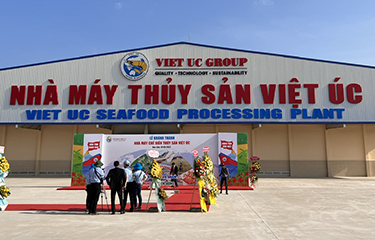
Viet Uc Seafood, Vietnam’s leading shrimp postlarvae supplier, has opened a shrimp-processing plant in southern Vietnam, completing the firm’s goal of becoming fully integrated along the shrimp value chain.
The Viet Uc-Bac Lieu shrimp processing plant, located in the Hi-Tech Agricultural Park in the coastal province of Bac Lieu, is the first in the country to have automation applied to more than 70 percent of its operations, according to the company.
The first phase of the processing project cost VND 200 billion (USD 8.6 million, EUR 8 million) to complete and has the capacity to process 5,000 metric tons (MT) per year. Viet Uc plans to double its investment into the plant to double its capacity, assuming market demand allows for it.
During its annual stakeholders meeting on 31 May, Viet Uc stated its aim to achieve associated revenue of VND 1.9 trillion (USD 83.3 million, EUR 77.4 million) in 2023, 12 percent higher than 2022, and attain net profit of VND 395 billion (USD 17 million, EUR 15.8 million), up 50 percent year-over-year.
The new plant is a major underlying factor for its ambitious objectives. Following the completion of its first phase of construction, the plant will primarily produce frozen cooked and raw vannamei for export to Australia, Europe, Japan, and the U.S.
Product for the plant will come from three of Viet Uc’s farms, covering a total area of 1,000 hectares, including two farms in Bac Lieu Province. Viet Uc is also considering buying shrimp from local qualified farmers to supplement its own production, Viet Uc Deputy Managing Director Vu Duc Tri told SeafoodSource.
Viet Uc will adhere to a strict definition of what it considers a “perfect shrimp,” which must be completely free from antibiotics or any toxic substances; and traceable, offering information on where the shrimp was farmed, how long it took to raise, and the aquafeed used, according to Tri.
Tri said several foreign buyers approached Viet Uc to discuss supply and investment opportunities before the plant was completed. Tri said the company is in discussions with various potential buyers, but is proceeding methodically in order to ensure proper calibration of its supply and processing output.
“We are still looking to cooperate with new strategic partners to maximize benefits in our shrimp and fish chains,” Tri said.
Viet Uc has expanded into processing at a delicate time for the shrimp sector, which is facing headwinds related to inflation and low global demand. The company expects those challenges will persist for several more years, forcing Viet Uc to optimize costs, focus on developing value-added products, improve product quality, and adjust its product structure to best meet the needs of each of its market segments, Tri said.
Founded in 2001, Viet Uc has experience navigating the ups and downs of both the global shrimp market and the local situation in Vietnam. Viet Uc operates three genetics and shrimp-breeding centers, and nine hatchery facilities across the country’s southern, central, and northern regions. It accounted for more than 30 percent of the total postlarvae supply in Vietnam last year and remains the only Vietnamese company selling its own shrimp broodstock, which began in 2017 after years of research and development. Vietnam’s other shrimp-farming firms import broodstock from the United States, Singapore, and Thailand, Tri said.
In March 2021, Viet Uc signed an agreement to sell a majority stake in its Viet Uc Aquafeed Company, which owns its aquafeed factory in Ben Tre Province, to Brande, Denmark-based BioMar. The partnership focuses on producing high-end feed products to meet sustainability, traceability, and quality requirements of the shrimp industry.
In an attempt to offset sole dependence on an inconsistent shrimp industry, Viet Uc is also branching into pangasius breeding, with plans to provide the market with high-quality fingerlings from its high-tech pangasius farm in Vietnam’s An Giang Province. In a statement, the company said good progress is being made on the project, without elaborating further.
Viet Uc began selecting first-parent pangasius for the project in 2016 and opened its 100-hectare farm pangasius-breeding farm, with a capacity of one billion pangasius fingerlings per year, in December 2018. Viet Uc recently added solar array to the facility to provide it with a cheaper, more renewable energy source.
The project is part of the country’s three-tier cooperation production plan for delivering high-quality pangasius breeds to companies operating in the Mekong Delta, the epicenter of the country’s pangasius industry. The plan, which runs through 2025, received approval from Vietnam’s Ministry of Agriculture and Rural Development in 2018.
Photo by Toan Dao/SeafoodSource
