






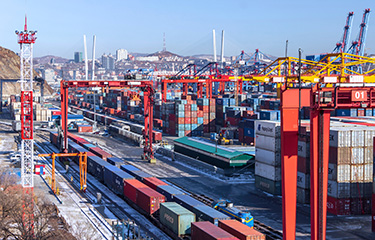
Russia has banned imports of Japanese seafood, following China’s lead in the wake of the controversial release of treated wastewater from the damaged Fukushima Daiichi Nuclear Power Station.
“As a precautionary measure, the Rosselkhoznadzor joins China's temporary restrictive measures against imports of fish and seafood from Japan from October 16, 2023,” Russia's Federal Service for Veterinary and Phytosanitary Supervision (Rosselkhoznadzor) announced on 16 October. “Restrictions are introduced until comprehensive information is provided to confirm the safety of aquatic products and compliance with the requirements of the Eurasian Economic Union, as well as its analysis by Rosselkhoznadzor specialists.”
Russia’s stated complaint and reasoning for the ban is a lack of transparency.
“We, unfortunately, do not see any transparency, that is, openness, in Tokyo's actions, this is what we called for," Ministry of Foreign Affairs Spokesperson Maria Zakharova said on 13 September. She also criticized Japan’s “advertising tricks” in which government officials and foreign dignitaries publicly ate fish from Fukushima Prefecture.
Following the announcement of the ban, two officials of Japan’s Ministry of Foreign Affairs protested the decision. Katsuro Kitagawa, Director-General of the Disarmament, Non-Proliferation and Science Department; and Tsuyoshi Kitagawa, Director of the Japan-Russia Economic Affairs Division; protested to Russian officials Gennadii Ovechko, Charge d'Affaires ad interim and Sergey Eliseev, Counsellor.
The protest said that Japan had responded in good faith to Russia’s sudden request for a dialogue on 10 October, and had provided requested information by a 16 October deadline unilaterally set by Russia.
"The decision by the Russian side is extremely regrettable, and we strongly request that it be withdrawn," the Japanese foreign ministry said in a statement.
The ban is mostly symbolic, since Japan imports a great deal of seafood – such as king crab, snow crab, and walleye pollock – from Russia, but doesn’t export nearly as much to the country.
According to data from a search on the Japan Customs website, Japan's fresh seafood exports to Russia in 2022 consisted of 1173 kilograms of Atlantic bluefin tuna and 1796 kilograms of Pacific bluefin, valued at a little over JPY 8 million (currently USD 53,482 or EUR 50,669) and JPY 12 million (USD 80,221, EUR 75,996), respectively.
Frozen seafood exports consisted of about 48,000 kilograms of Pacific saury valued at around JPY 14.4 million (USD 96,270, EUR 91,219), and 224 kilograms of yellowtail (Seriola species), valued at JPY 1.2 million (USD 8,021, EUR 7,600).
Fillets in both fresh and frozen form consisted of 6,345 kilograms of yellowtail valued at JPY 28.5 million (USD 190,530 or EUR 180,546), and 240 kilograms of other fillets valued at JPY 1.3 million (USD 8,690, EUR 8,235).
All told, the combined value of seafood exports only amounts to JPY 65.4 million (USD 431,200, EUR 408,500), but Japan has sought to show most countries accept the release of treated cooling water from the reactor as safe, and that China’s ban lacks a scientific basis. If additional countries ban Japanese seafood, it becomes harder to isolate China on the issue.
Russia’s actions are more of an act of diplomatic solidarity with China, which has been an important ally in preventing the economic isolation of Russia by Western sanctions related to the war in Ukraine.
Conversely, if Japan were to retaliate by banning Russian seafood, the effect would be thousands of times larger in value terms. In 2022, the country imported a record JPY 155.2 billion (USD 1.14 billion, EUR 1.05 billion at the time) worth of seafood from Russia.
Japan is not the only country facing an import ban from Russia. Russia banned seafood imports from “unfriendly” countries that imposed economic sanctions against Russian citizens and companies in 2014 in response to U.S. and E.U. sanctions imposed on Russia following its annexation of Crimea.
The ban list included agricultural produce, raw materials, and food products that originated in the U.S., the E.U., Canada, Australia, and Norway. The original ban was for one year, and the ban has been renewed annually since. On 18 September 2023, President Putin signed a new decree extending the ban through the end of 2024.
The number of affected items was increased in July 2023 to include ready or canned fish; sturgeon caviar and its substitutes made from fish eggs; and prepared or preserved crustaceans, mollusks, and other aquatic invertebrates.
Photo courtesy of Urri
