





Scientific predictions of a coastal El Niño have Peru’s fishing industry calling for an early start to the fishing season to avoid a sharp drop in catch and potential economic hardship.
Peru’s Estudio National del Fenómeno de El Niño (ENFEN) climate agency – a multisectoral scientific technical entity charged with monitoring ocean and atmosphere anomalies to give an early warning for the El Niño phenomenon – has warned of a coastal El Niño. The phenomenon typically results in higher-than-usual rainfall along Peru’s northern coastline, and ENFEN has not ruled out more extreme events and flooding.
The warning has Peru’s fishing industry scrambling to prepare, anticipating a challenging year marked by severe weather events.
PRODUMAR – part of Spain’s Profand Group specializing in the production, processing, and sales of seafood – has added an additional USD 100,000 (EUR 86,000) to its capex this year to reinforce its roofs and infrastructure.
“We are facing an unforeseen expense. In the capex that we approved in November 2025, we did not foresee these rains or an El Niño phenomenon. Up until October, the forecast was for normal conditions,” PRODUMAR CEO Gerardo Carrera told local publication Semana Económica.
Likewise, Pesquera Exalmar CFO Raúl Briceño said the company and its sister agro-industrial firm Beta had committed lines of working capital of USD 50 million (EUR 43 million) should they need to draw upon them to improve liquidity, considering the climate phenomenon that leads to warmer waters off the coast and heavy rainfall on land.
The anomaly has particularly raised red flags in Peru’s anchovy fishery – one of the world’s largest by volume. The fishery is highly important both for the country as it brings in billions of dollars in revenue, and for the global seafood industry as the anchovy catch is used to produce about 20 percent of global fishmeal supplies.
Peru’s National Fisheries Society (SNP) is actively coordinating with the Production Ministry (PRODUCE) to evaluate the possibility of bumping up the launch of the year’s first anchovy fishing season in the north-central area – Peru’s main anchovy fishing grounds.
“The potential start of El Niño coincides with the start of the season. If we do things as usual and leave [the launch] to around mid-April, the sea will probably be already too warm and we won’t find any resources,” SNP President Jessica Luna said.
Luna has recent historical precedent to point to as the SNP makes its case for an early start. Previous years affected by El Niño weather patterns hit the country’s anchovy fishery hard; in January 2024, PRODUCE closed the country’s second anchovy season early, following the complete cancellation of the first season of 2023, which she called “the worst year in decades.”
The poor fishing season led to significant economic impacts, including a 0.5 percent drop in national GDP and more than USD 1.4 billion (EUR 1.2 billion) in lost fishmeal and fish oil exports, while several thousand fishing-dependent families were affected and fishing ports “looked like ghost towns.”
Luna has been actively speaking out regarding the risks of a tardy launch of the anchovy fishing season. In a series of posts on the SNP’s website, she pointed out the second season for the North-Central zone in 2025 got a slightly later start than the same season of 2024. While Peru’s industrial fishing fleet still managed to capture 1.6 million metric tons (MT) of the total allowable catch (TAC) – 98 percent of the 1.63-million-MT quota – the timing of that catch is evident of the need to start earlier, Luna said.
“The [2025] season started seven days later than in 2024 – valuable time to sustainably use the resource. In this period [of 2024], 238,000 MT were caught, a volume equivalent to 14.5 percent of the quota assigned for the second season of 2025,” she said. “In the last two years alone, both in the first and second seasons, we’ve observed an increase in the catches of the first days of fishing.”
Starting the season in a prompt fashion is particularly pressing when considering the Coastal El Niño warnings, she said, which tends to be more sudden – and should have triggered a rapid response from Peruvian authorities.
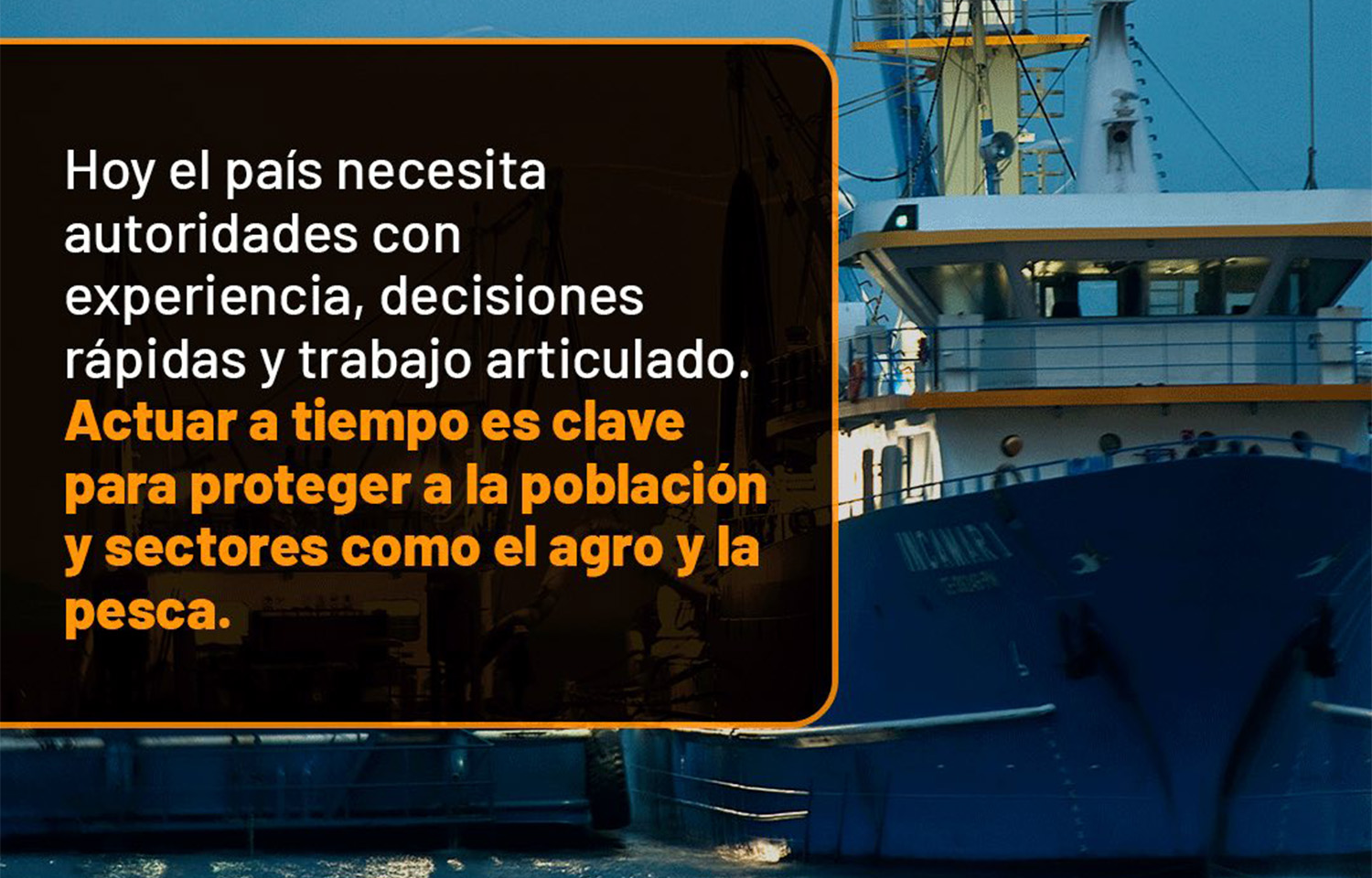
“However, we do not see an action plan from our authorities to minimize the impact of an eventual El Niño,” Luna said.
Political instability could be a factor in that lack of an action plan; as of March 2026, Peru has had seven different presidents within the last 10 years. Heavy rains already resulting in flooding and landslides, affecting cities such as Arequipa and Piura, could mean that Coastal El Niño has already begun, Luna said, but “there is a lack of prevention and action on the part of the state.”
She called on authorities and experienced technical teams to focus on meeting the needs of the population.
“There is no room for improvisation. Stability and committed authorities are required to make correct and timely decisions for the benefit of the country,” Luna said. “Not doing so and starting late would put this engine of economic growth at risk, as well as the incomes of the thousands of workers who operate in the industry. We have been warned.”
