

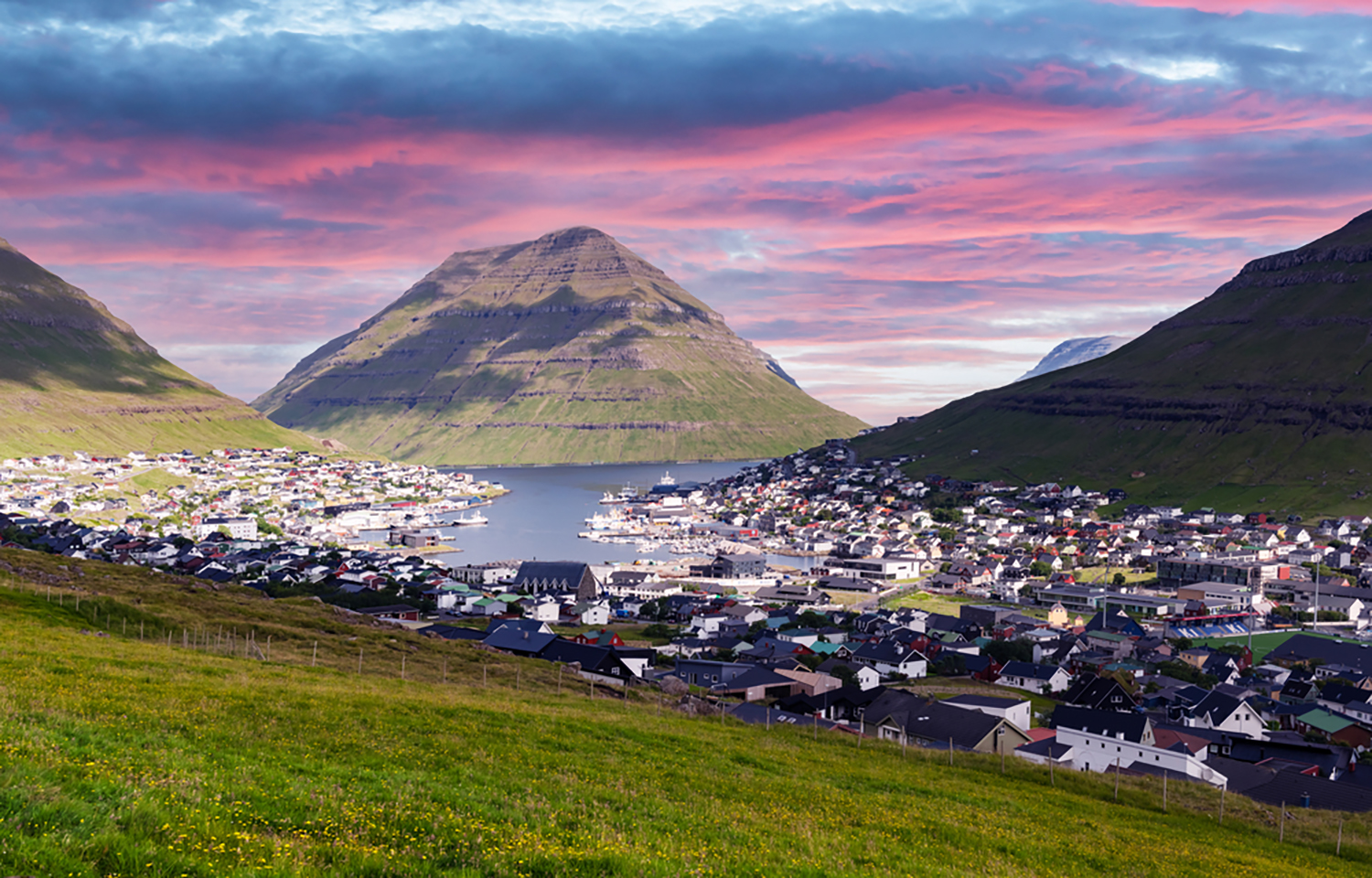
Fishing has always been a part of the culture of Klaksvík, a town of around 5,100 residents in the Northeastern Faroe Islands.
In the mid-20th century, Klaksvík, the roots of which stem back to when Vikings ruled over the islands, emerged as a fisheries hub, with a fleet consisting primarily of small boats.
Today, most fishermen in the town work for large fishing firms on super-trawlers, which fish for cod in the Barents Sea or for pelagic species such as mackerel, blue whiting, or herring in the Northeast Atlantic Ocean.
However, a few Klaksvík locals have hung on to the traditional ways of small-scale fishing.
One of those fishermen is Finnbjørn Vang, who works for the fishing firm Norðsøki with his father Eyðólvur and his brother Heri, all of whom are worried the practice will soon die out in the small town of Klaksvík and beyond.
Finnbjørn, who is the chairman of the Small-Scale Fisheries Union in the Faroes, said that politicians have little interest in improving the conditions of small-scale fishers. He said that while the Faroese government provides some financial support for research into fisheries, all of the money typically goes to bigger pelagic ships, and there is little political will to find innovative ways to improve small-scale fisheries.
"It's not enough to send an email with the possibility to send comments [that lead to new legislation or regulation]. The minister should invite us to come and have a real conversation about possibilities in the industry," he said.
In the Faroes, quotas regulate the number of “fishing days” each vessel can go out to sea; essentially, each vessel with a fishing license has a certain number of fishing days and can fish for a limited time during those days.
But with essential fishing stocks like cod declining, politicians have taken actions that disproportionately affect small-scale fishers, Finnbjørn said.
He explained that when stocks show declines, regulators typically reduce fishing days across the entire industry, overlooking the fact that one day of fishing significantly impacts small-scale vessels in particular, which cannot fish in all weather conditions. Simultaneously, the fishing pressure produced by the small fleet is substantially smaller than that of larger longliners or trawlers, Finnbjørn argued.
"I refuse to believe that our kind of fisheries destroy any stocks," he said.
Elsewhere, small-scale fishers are in similarly dire positions.
In the Philippines, the nation’s Supreme Court recently ruled that commercial fishing vessels are allowed to operate within Philippine nearshore municipal waters, which have traditionally been reserved solely for small-scale fishing use.
“The Supreme Court ruling has wide-reaching and increasingly evident impacts that harm fishing associations and small-scale fishers,” Oceana Vice President Von Hernandez said on the ruling. “As duty bearers, it is essential for the government to assess how this ruling weakens and jeopardizes the entire framework that sustainability certifications rely on, particularly traceability, fairness for artisanal fishers, and compliance to environmental standards.”
In the U.K., small-scale fishers have expressed grave concerns over a recent E.U.-U.K. deal that some are saying could be the death blow for the U.K.’s under-10-meter fleet, which represents around 80 percent of the total vessels operating in the country.
"With this long-term deal, our fate really is sealed,” Jerry Percy, the former director of the New Under Ten Fishermen’s Association (NUTFA), told SeafoodSource in July. “To be honest, there's nothing we can do. They've agreed on everything for years and years ahead, which is probably the worst negotiating position you can have.”
Last year, Seas At Risk, a European association of environmental organizations, released a report on possible business models small-scale fishers can employ to run sustainable operations, which stated that "a select group of large-scale industrial operators have increasingly consolidated ownership of capital, fishing capacity, and allocation of fishing rights.”
Like many other families in Klaksvík and across the world, fishing has been a generational business for Finnbjørn, who descends from fishermen across both family lines.
His maternal great-grandfather, for example, was a legendary fisherman in Klaksvík and earned the nickname "Jógvan the Lonely" because he always went fishing alone in a rowing boat, refusing to upgrade when everyone else switched to engines.
That kind of stubbornness and persistence that Jógvan the Lonely showed has provided the motivation for his family to continue fishing on small boats, Finnbjørn said – albeit on more modern vessels than his great-grandfather’s rowing boat.
Heri, Finnbjørn's little brother, heads up Norðsøki now.
Each member of the company’s small crew works six days a week during the fishing season. Finnbjørn said that his brother could be working on a bigger vessel and make much more money but has chosen to maintain the family business.
"He wants to do these kinds of fisheries, and it has to be with Norðsøki," Finnbjørn said, whose father Eyðólvur is still part of the crew at 72 years old.
Even though the family business has survived over the years, Finnbjørn said he doubts that the business will be financially viable enough to be passed down too many more generations.
Finnbjørn has one son and two daughters, while Heri has two daughters, and although Finnbjørn said he would love for the daughters to take over, he said that idyllic vision might not be realistic.
Still, as governments around the world make the slow transition toward prioritizing environmental protection in their regulatory frameworks, if it can hold on, small-scale fishing represents a logical sector to bolster through funding and research development.
“Small-scale, low-impact fishing plays a vital role in supporting livelihoods and local economies. These fishing practices provide employment opportunities that contribute to economic stability and support local food systems by supplying fresh seafood to local markets,” the 2024 Seas At Risk report said. “Moreover, small-scale low-impact fisheries are often more sustainable, helping to preserve marine ecosystems and maintain biodiversity. They are, therefore, not only essential for supporting the livelihoods of local communities but also for fostering local economic development and maintaining ecological balance.”
