




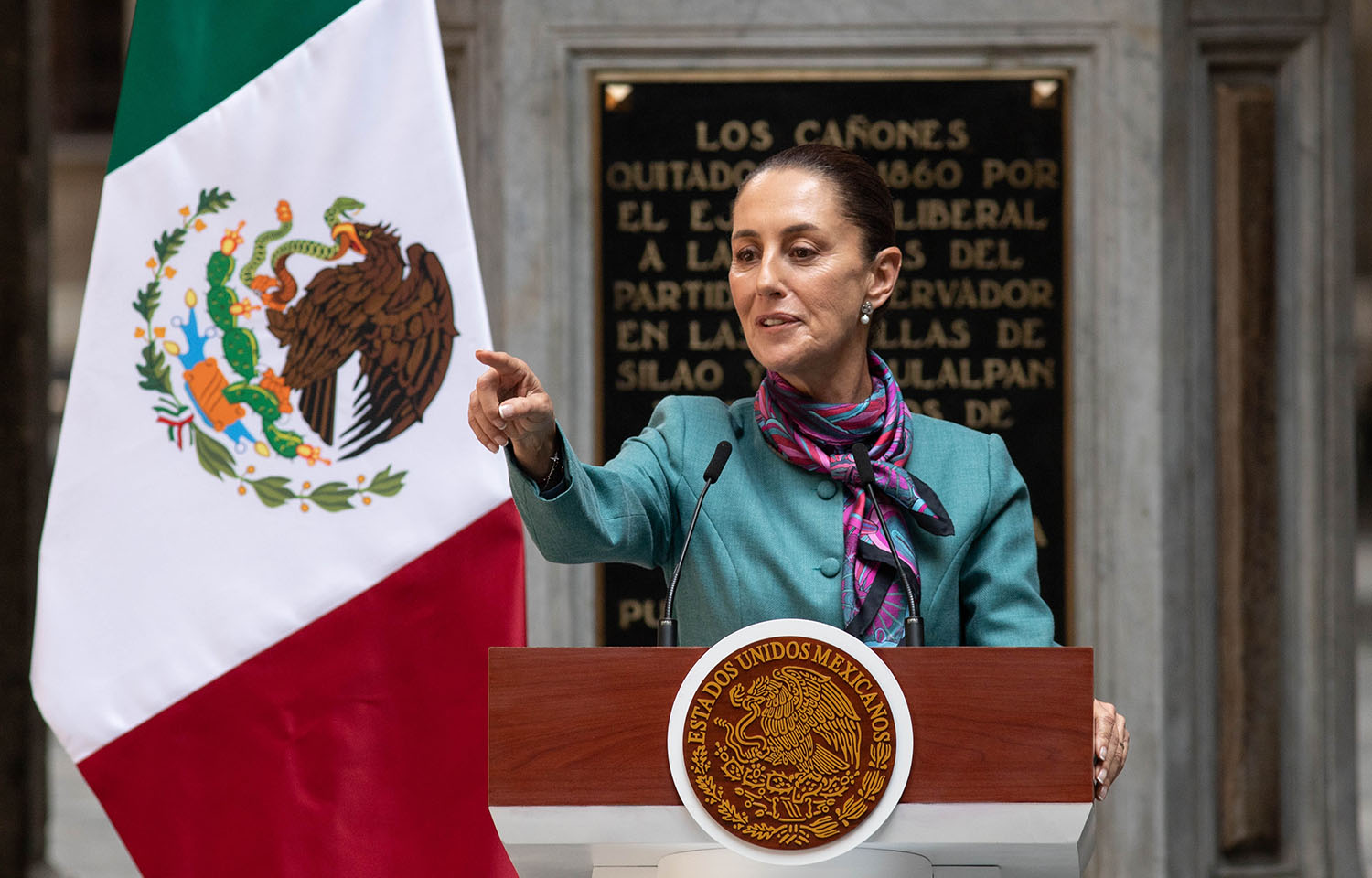
U.S. President Donald Trump announced on his social media platform Truth Social that he is pausing planned 25 percent tariffs on Mexico for one month following a conversation with Mexican President Claudia Sheinbaum.
Trump announced a set of sweeping tariffs on Canada, Mexico, and China on 1 February, following through on a proposal he made in November 2024.
Trump’s proposal would hit Canada and Mexico with sweeping 25 percent tariffs across all goods excepting Canadian energy – which would be tariffed at 10 percent – and an additional 10 percent tariff on top of the existing tariffs he enacted on Chinese goods during his first term as president.
According to Trump, he paused the tariffs for a month after Sheinbaum agreed to station 10,000 Mexican soldiers on the country’s northern border between it and the U.S.
“These soldiers will be specifically designated to stop the flow of fentanyl and illegal migrants into our country,” Trump wrote. “We further agreed to immediately pause the anticipated tariffs for a one-month period during which we will have negotiations headed by Secretary of State Marco Rubio, Secretary of Treasury Scott Bessent, and Secretary of Commerce Howard Lutnick, and high-level Representatives of Mexico. I look forward to participating in those negotiations, with President Sheinbaum, as we attempt to achieve a ‘deal’ between our two Countries.”
Trump also said he has a phone call with Canadian Prime Minister Justin Trudeau scheduled for 3 p.m. EST to discuss the imminent trade action.
The National Retail Federation criticized the decision to pursue tariffs and encouraged “all parties” to continue negotiations.
“The retail industry is committed to working with President Trump and his administration to achieve his campaign promises, including strengthening the U.S. economy, extending his successful Tax Cuts and Jobs Act and ensuring that American families are protected from higher costs,” it said.
As negotiations on the tariffs continue, companies in the U.S. and Canada have been preparing for any outcome.
Atlantic Sapphire, in an announcement posted to the Oslo Børs, said it predominantly sources feed for its Miami, Florida, U.S.A.-based salmon recirculating aquaculture system from Skretting-owned feed mills in Canada.
“The newly announced U.S. import tariffs on Canadian products will significantly affect the cost of this imported feed,” the company said. “In response, Atlantic Sapphire is evaluating options to mitigate the impact of these tariffs. This includes considering alternative sources of feed from non-Canadian mills.”
Paul Jewer, the CEO of Lunenburg, Nova Scotia, Canada-based High Liner Foods, said on a post on LinkedIn the company is navigating its way through potential challenges caused by the tariffs. High Liner owns and operates seafood-processing facilities in both the U.S. and Canada.
“To say this is a disappointment would be an understatement,” Jewer said of the tariffs. “As a company, we deeply value our employees and the relationships and businesses that exist on both sides of the border. These tariffs are an affront to the strong relationship between Canada and the United States, and more importantly, they are designed to divide us, rather than recognize the united strength that we have.”
Jewer said the tariffs will cause challenges for the entire seafood industry in both countries but added High Liner has faced adversity before – including previously imposed U.S. tariffs.
“With our diverse and fully integrated supply chain and manufacturing facilities located on both sides of the border, we are in a strong position to navigate these changes while continuing to serve our customers,” Jewer said. “We are also in ongoing discussions with industry partners and trade officials in both Canada and the U.S. to ensure our concerns are heard.”
Supreme Crab & Seafood Chief Executive Officer Troy Turkin told SeafoodSource the company is taking a “wait and see” approach to potential tariffs.
“We will continue importing from China and will see how the new season’s raw material costs look,” Turkin said. “The new season doesn’t begin until August, so it is a fluid situation that will not have an immediate impact to our customers.”
Turkin predicted during the 2025 Global Seafood Market Conference that tariffs could have a big impact on the pasteurized crab meat market – particularly for red swimming crab, as the species is only produced in China and Vietnam.
Peter Quinter, a U.S. customs and international trade attorney at Florida-based law firm Gunster, told SeafoodSource there will likely be movement at the World Trade Organization (WTO) regarding the tariffs but that he expects any action will have little impact.
“Unfortunately, the bureaucratic process of the WTO means we will not have a decision for years, so the negative effect of these new Trump tariffs will already have occurred,” Quinter said.
As was the case with Trump’s prior tariffs against China, the president is using his powers under the International Emergency Economic Powers Act of 1977, which granted the president the authority to impose tariffs after declaring a national emergency.
“The legal question is whether the alleged explanation for these extraordinary tariffs is a ‘national emergency.’ I do not think so, but the courts tend to defer such matters to the Executive Branch, especially the president,” he said.
Quinter said while the tariffs against Mexico are paused for now, higher tariffs are likely coming “sooner or later.”
“The resulting higher prices are to follow. U.S. companies will continue to spread the supply chain away from China, but the chaos that Trump created with additional tariffs on Canada, Mexico, and eventually the E.U. has created chaos among U.S. executives to know where to focus sourcing merchandise,” Quinter said. “The delay proves that there really is no ‘national emergency,’ which was the pretext by Trump to announce these extraordinary tariffs.”
