





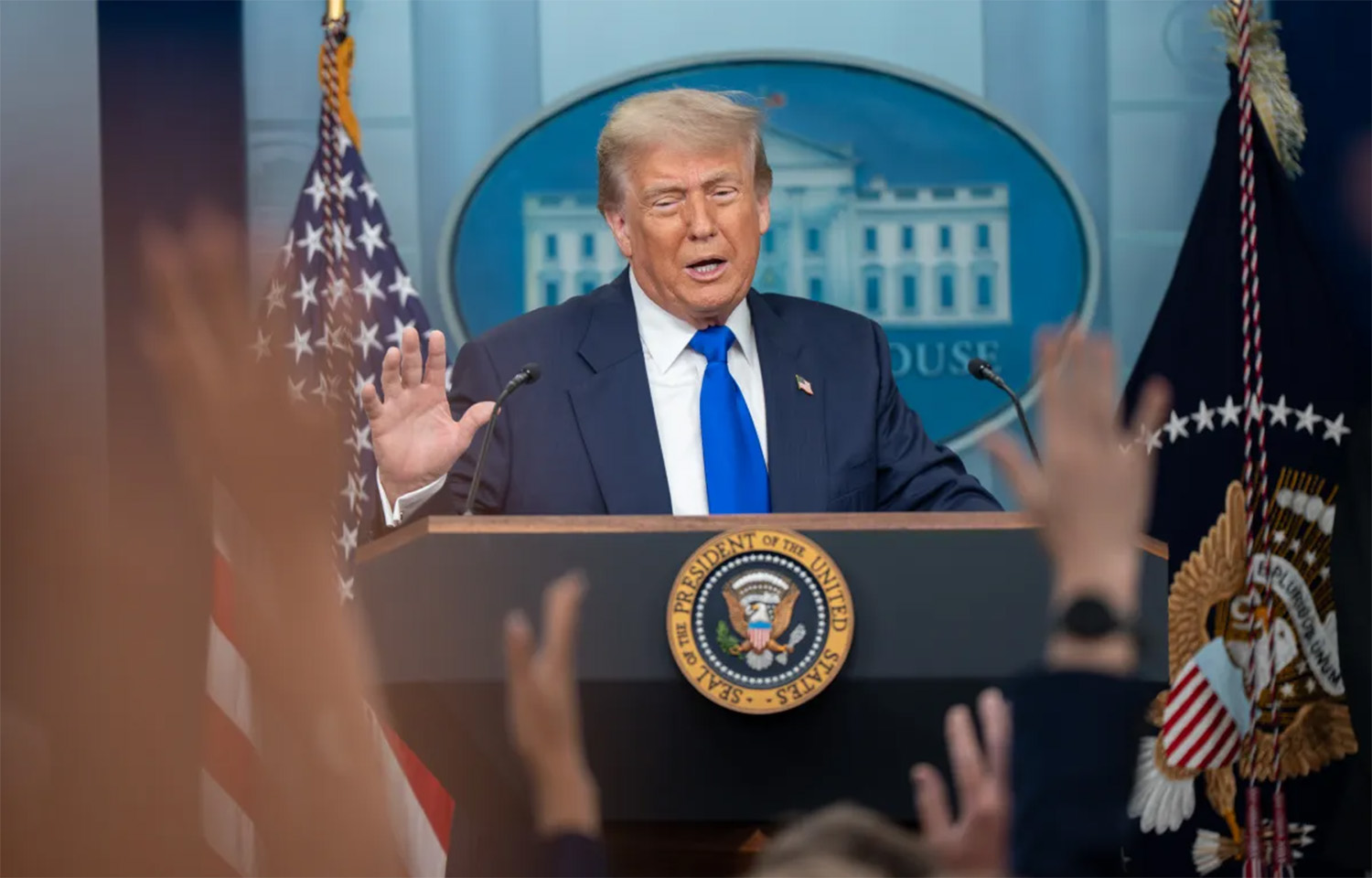
U.S. President Donald Trump threatened to add an additional 10 percent tariff to any country aligned with BRICS (Brazil, Russia, India, China, and South Africa) and then later threatened 25 percent tariffs as of 1 August on China, South Korea, and Japan, just before the White house announced his intention to extend the “liberation day” tariff pause to 1 August.
White House Press Secretary Karoline Leavitt told media on 7 July that Trump was planning to sign an order to extend the pause on the steepest tariffs until 1 August. She also said Trump was planning to send letters to other countries about the new rates they would face if they did not negotiate new deals with the U.S.
The pause came after a string of tariff-related activity from Trump on 6 and 7 July. In a post on his social media platform Truth Social on 6 July, Trump said any country “aligning themselves with the Anti-American policies of BRICS” would be hit with the additional tariff, without providing any further details. The announcement comes as BRICS-aligned countries – Brazil, Russia, India, China, South Africa, Egypt, Ethiopia, Indonesia, Iran and the United Arab Emirates – began a two-day summit in Rio de Janerio, Brazil.
“There will be no exceptions to this policy,” Trump wrote.
The move came after BRICS leaders issued a statement that criticized trade restrictions.
“We voice serious concerns about the rise of unilateral tariff and non-tariff measures which distort trade and are inconsistent with [World Trade Organization] rules,” BRICS members stated.
Just over 12 hours later on 7 July, Trump released a letter he sent to South Korea President Lee Jae-myung that threatened to increase tariffs on the country to 25 percent starting 1 August 2025.
“Our relationship has been, unfortunately, far from Reciprocal,” the letter states.
It also said any retaliation by South Korea would be met in kind.
“If for any reason you decide to raise your Tariffs, then, whatever number you choose to raise them by will be added onto the 25 percent that we charge,” Trump’s letter states. “Please understand that these Tariffs are necessary to correct many years of Korea’s Tariff, and Non Tariff, Policies and Trade Barriers, causing these unsustainable Trade Deficits against the United States.”
A White House spokesperson later confirmed to the New York Times that the 25 percent would be in addition to the 10 percent “baseline” named on 2 April. As currently stated, the new threats of tariffs against Japan and Korea are nearly the same as the tariff threats from “liberation day,” the name Trump gave to his 2 April tariff announcement.
The statement on BRICS and the letters sent to Japan, South Korea, and China came as Trump’s “reciprocal” tariffs from “liberation day” were supposed to take effect on 9 July after a 90-day pause, which the president said was intended to give time for countries to make deals with the United States. That pause will apparently be extended, though the details of that extension are unclear.
The reciprocal tariffs vary depending on the country, with most of the U.S.’s major seafood sources being hit with tariffs above the minimum 10 percent tariff that has already been in place. India, which was the top source of U.S. shrimp imports in 2024 and in 2023, would be hit with a 27 percent tariff, while Indonesia, the fourth-largest exporter of seafood to the U.S., would be hit with a 32 percent tariff.
The fifth-largest exporter, Vietnam, was recently spared tariffs as high as 46 percent as the country struck a deal with the U.S. that would see U.S. goods enter Japan with no tariffs, while Vietnamese goods entering the U.S. would be subject to a 20 percent tariff. Additional, transshipments through third countries through Vietnam would face a 40 percent tariff.
