




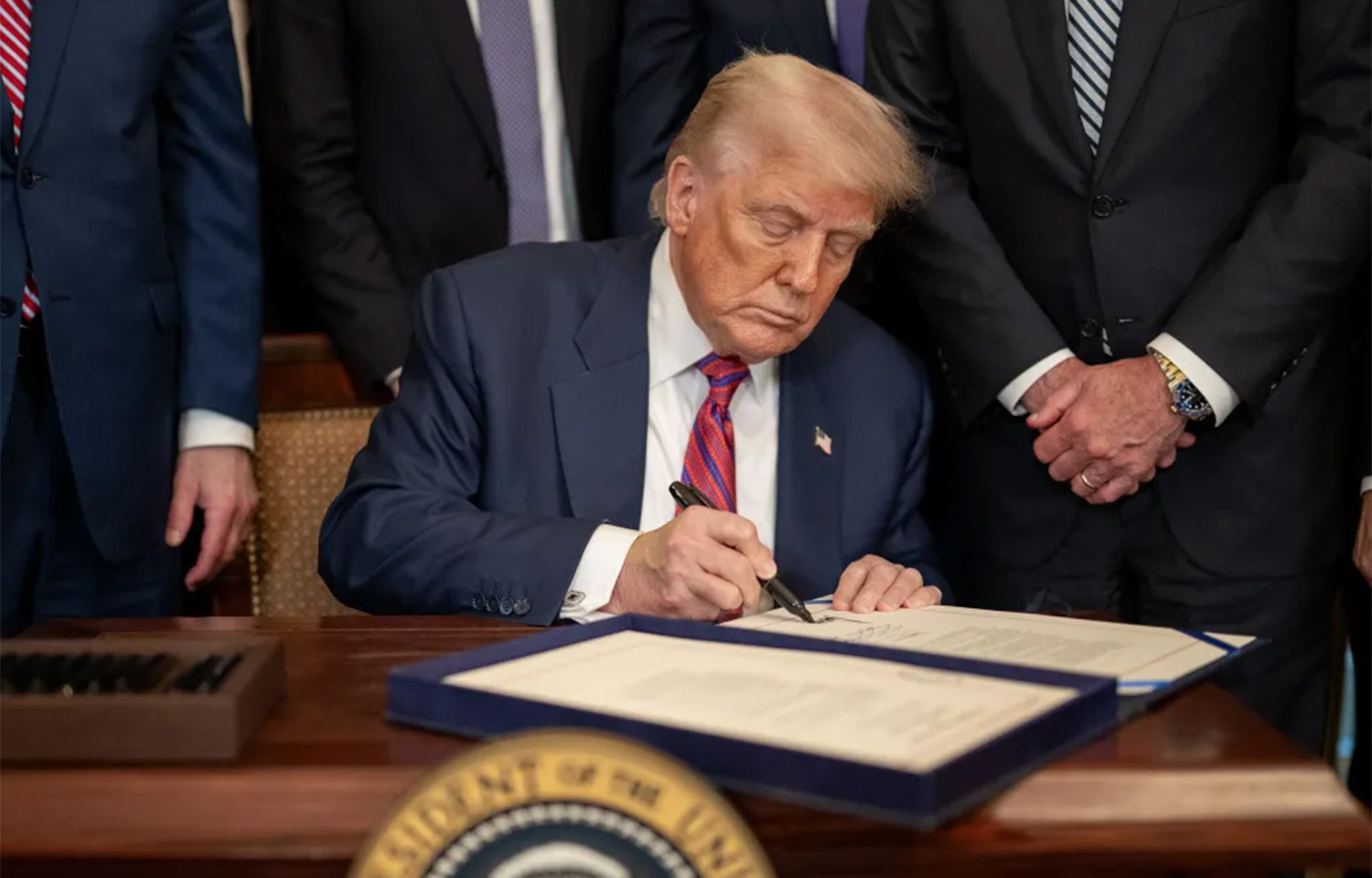
U.S. President Donald Trump issued an executive order on 31 July codifying a new swath of tariffs on dozens of countries.
The order comes as an 1 August deadline, set after Trump threatened increased tariffs before pausing their implementation days later, passes. The new order further modifies tariff rates and implements a range of different tariffs on 69 countries and the European Union as a whole.
“I have received additional information and recommendations from various senior officials on, among other things, the continued lack of reciprocity in our bilateral trade relationships and the impact of foreign trading partners’ disparate tariff rates and non-tariff barriers on U.S. exports, the domestic manufacturing base, critical supply chains, and the defense industrial base,” Trump’s executive order states.
The order said the U.S. is still negotiating “meaningful trade and security commitments” with a number of trading partners but that others have offered terms that “do not sufficiently address imbalances in our trading relationship.”
Under the latest set of tariff announcements, 27 different countries are now being hit with tariffs higher than 15 percent, and a further 40 countries and the E.U. are now being hit with tariffs of 15 percent.
According to NOAA Fisheries import statistics, of the countries that are listed as having a higher than 15 percent tariff, India is by far the largest seafood trading partner with the U.S. India sent over USD 2.4 billion (EUR 2 billion) worth of seafood to the U.S. in 2024, and it has consistently been one of the top exporters of shrimp to the U.S. In 2024, the country sent 294,318 metric tons (MT) of shrimp in 2024, beating out second-place Ecuador by over 100,000 MT.
Indonesia is the next-largest seafood trading partner that will now be hit by a higher tariff. Trump announced a trade deal with Indonesia in mid-July that set the country’s tariff rate at 19 percent – down from the 32 percent initially announced in April. Indonesia was the fourth-largest exporter of seafood to the U.S. in 2024, exporting just under USD 1.9 billion (EUR 1.6 billion) worth of seafood to the U.S., meaning the 19 percent tariff would have cost importers an additional USD 361 million (EUR 312 million) last year had they been in place.
Just behind Indonesia is Vietnam, which also negotiated a trade deal with the U.S. to set its tariff rate at 20 percent, down from the 42 percent it was initially threatened with. Vietnam was the fifth-largest exporter of seafood to the U.S. in 2024, and the Southeast Asian country sent USD 1.71 million (EUR 1.47 billion) worth of seafood to the U.S. during the year.
Thailand will also be hit with a tariff rate of 19 percent after Trump announced a trade deal with the country, dropping its tariff rate down from a planned 36 percent. The country exported USD 1.1 billion (EUR 950 million) worth of seafood to the U.S. in 2024, making it another top seafood trading partner.
The new announcements have hit Brazil the hardest of any country, as it is now subject to the 50 percent tariff that Trump began to hint at in early July when he targeted countries in BRICS – Brazil, Russia, India, China, and South Africa – with higher tariffs. Just days later, he increased the threat on Brazil to 50 percent tariffs in response to the country’s ongoing prosecution of former Brazilian President Jair Bolsonaro, who is accused of orchestrating an attempted coup after losing elections in 2022. Then, on 31 July, Trump announced he was implementing the 50 percent tariff.
Of the countries being hit by tariffs higher than 50 percent, Brazil is in the top five in terms of its seafood export value to the U.S., shipping USD 220 million (EUR 190 million) worth of seafood to the country in 2024. A 50 percent tariff on seafood would therefore have cost U.S. importers USD 110 million (EUR 95 million) last year.
Other notable countries among those being tariffed above 15 percent are the Philippines, Taiwan, Nicaragua, South Africa, and Sri Lanka.
Outside the countries above 15 percent, a number of top seafood exporting countries’ tariff rates are being increased from 10 to 15 percent. Those countries include major seafood trading partners like Ecuador, Norway, Iceland, New Zealand, Turkey, Venezuela, and Costa Rica.
Some top seafood trading partners are keeping the lower 10 percent tariff, including Australia, Honduras, the Bahamas, Morocco, and Peru.
The big winner at the moment is Chile, which is the second-largest source of seafood by value in the U.S. at USD 2.9 billion (EUR 2.5 billion) and is now the only country in the top 10 exporters to face a tariff of just 10 percent.
