






Chile’s Superintendency of the Environment (SMA) charged Salmones Camanchaca on 12 June with alleged overproduction at its Leucayec grow-out center in the southern Aysén region.
According SMA’s national information system on environmental audits (Snifa), Camanchaca allegedly surpassed its 5,000 MT production limit by 14.6 percent, or 728 metric tons (MT), between March 2019 and July 2020.
On 13 June, SMA filed overproduction charges against the multiple operators of the Isla Juan grow-out center, located in the Magallanes region, for allegedly surpassing the farm’s 5,200 MT limit by 1,092 MT between June 2018 and July 2020.
Salmones Austral subsidiary Trusal was the holder of the aquaculture concession at the time, but Cermaq Chile was leasing the center. Salmones Porvenir took over the farm in August 2021 and is also listed in the SMA documents.
"[Overproduction] directly threatens the sustainability of the aquaculture sector since the entire system of standards and authorizations considered in establishing optimal production, compatible with the capacity levels of lakes, [as well as] fluvial and/or maritime bodies of water, is violated,” SMA said in its complaint.
Overproduction generates an increased contribution of organic and inorganic matter and also raises the risk of fish escapes and the spread of fish diseases and prophylactic drugs into the marine environment, the SMA said. Higher-than-permitted fish-farming densities also have a negative impact on the availability of dissolved oxygen in the water column and water-flow.
Chilean authorities have initiated a legal crackdown on salmon farming rules violations since Chile President Gabriel Boric entered office in January 2022, and that effort has been ramped up further in recent months. In February, the National Fisheries and Aquaculture Service (Sernapesca) passed on information regarding overproduction to SMA, which subsequently initiated sanctioning processes against salmon firms in the Aysén and Magallanes regions. These included two Nova Austral operations and one Blumar farm in the Magallanes region, as well as a Multiexport grow-out center and one Mowi farm in the Aysén region.
SMA also took action against Nova Austral for alleged overproduction at three grow-out centers within Alberto de Agostini National Park, and against Cooke Chile for alleged overproduction at farms located within the boundaries of national park s. Cooke has denied the allegations and called SMA's enforcement efforts arbitrary.
SMA has also taken action against Australis, accusing it of 85,000 MT of overproduction between 2014 and 2022. Australis admitted to some overproduction via self-reports to the SMA, acknowledging it surpassed permitted production limits at 33 salmon grow-out centers. On 25 April, in response to both the self-reported violations and its own investigations, SMA filed 21 sanctioning procedures against Australis, including 52 serious infractions for overproduction and five minor charges for other environmental breaches.The company faces a total fine equivalent of up to CLP 178 billion (USD 221 million, EUR 203 million).
Sernapesca has also been active in inspecting salmon-farming operations. It recently filed four new complaints with SMA for lesser infractions, all in the Magallanes region. Three of those regarded failure to remove waste from operations at Salmones Blumar, Australis Mar, and Nova Austral, while the fourth is related to Australis’s reported unauthorized injection of nanobubbles into the water column at a farm located in the Golfo Xaltegua sector.
“Sernapesca in Magallanes will ask the industry representatives for a working group to optimize the management of waste and garbage generated by the farming centers, a matter on which complaints continue to be received from the community,” Sernapesca Magallanes Regional Director Patricio Díaz said in a release. “In the same light, it is noted that any work or intervention in the water column must have the prior authorization of the sectoral authority.”
Chile's salmon-farming industry recorded USD 6.6 billion (EUR 6.1 billion) in exports in 2022.
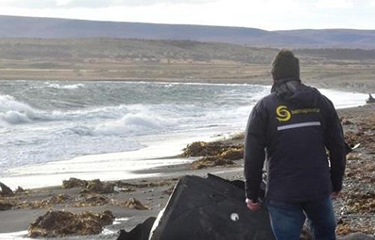
Photo courtesy of Sernapesca
